The Real Florida Tax Math: How Much You Actually Save Moving to Sarasota
Darren Dowling

Darren Dowling
Florida has no state income tax.
If you are relocating from New York, Illinois, California, or New Jersey, those five words carry enormous financial weight. But income tax is just one part of the picture. When you factor in property tax differences, estate and inheritance tax advantages, and the compounding effect of the Save Our Homes property tax protection, the total annual financial benefit of calling Sarasota home can be substantial often tens of thousands of dollars per year for high-earning households.
This post does the actual math, using real tax rates and realistic household scenarios. It is not investment advice, and every household's situation is unique but for buyers considering a move to Sarasota, understanding these numbers is an essential part of making an informed decision. We recommend working with a CPA and estate attorney who understand both Florida law and the laws of your current state.
What Florida Does Not Tax
Florida imposes no state income tax on individuals. This means residents pay zero state taxes on:
Wages and salaries
Investment income (dividends, capital gains, rental income)
Retirement income including pension distributions
IRA and 401(k) withdrawals
Social Security benefits
Business income passed through on personal returns
Compare this to the tax rates in the states where most Sarasota buyers originate:
New York State: Marginal income tax rates range from 4% to 10.9%, with New York City adding an additional 3.08% to 3.876% on top for city residents. A household with $300,000 in taxable income in New York could owe $25,000 or more in state and city income taxes combined.
Illinois: A flat state income tax rate of 4.95% applies to all income. On $300,000 in taxable income, that is approximately $14,850 owed to the state annually.
California: The most aggressive income tax structure in the country, with marginal rates reaching 13.3% on income above approximately $1 million and 9.3% on income from $66,296 to $338,639 (2024 brackets). On $300,000 in taxable income, a California resident might owe $20,000 to $24,000 in state income tax.
New Jersey: Marginal rates ranging from 1.4% to 10.75%, with the top bracket applying to income above $1 million. A household with $300,000 in income would owe approximately $14,000 to $17,000 in state income tax.
Michigan: A flat income tax rate of 4.25%, plus local income taxes in many cities. On $300,000, this represents approximately $12,750 in state tax.
The Florida Income Tax Advantage: A Sample Household
Consider a retired couple relocating from New York with the following profile: combined income of $350,000 from retirement accounts, investment income, and part-time consulting. In their final year as New York State residents (not NYC), their state income tax obligation could be in the range of $28,000 to $32,000.
In Florida: $0.
That is a one-year savings of $28,000 to $32,000 before accounting for any other differences. Over a 20-year retirement, with modest income growth, that savings compounds into a genuinely life-altering number.
For a higher-income household executives with stock compensation, business owners, or dual-income professional couples with $500,000+ in combined income the annual state income tax savings can exceed $40,000 to $55,000 or more, depending on the prior state.
How Florida Property Taxes Work
Florida does impose property taxes, and buyers should factor these in carefully rather than assume the Sunshine State is a low-tax environment across the board. Property taxes in Florida are calculated by multiplying a property's taxable assessed value by the combined millage rate of all applicable taxing authorities.
In Sarasota County for fiscal year 2026, the total combined millage rate for unincorporated areas (outside city limits) is approximately 11.47 mills covering the county government, school board, hospital district, emergency medical services, water management, and other special districts. One mill equals $1 per $1,000 of taxable value.
For a home with a market value of $600,000 purchased by a full-time Florida resident who qualifies for the Homestead Exemption (which reduces taxable value by up to $50,000), the annual property tax calculation works roughly as follows:
Assessed value: $600,000
Less Homestead Exemption: $50,000
Taxable value: $550,000
At 11.47 mills: approximately $6,309 per year
That is the baseline for year one. One of the most important long-term advantages of homesteading a Florida property is the Save Our Homes cap, which limits the annual increase in assessed value to 3% or the Consumer Price Index, whichever is lower. (See Blog 3 in this series for a complete guide to the Homestead Exemption and how this protection works in practice.)
Comparing Property Taxes: Florida vs. High-Tax Northern Markets
For buyers relocating from New York, New Jersey, Illinois, and Connecticut, Florida property taxes even without major exemptions can be significantly lower in absolute dollar terms, despite a higher effective rate percentage in some comparisons.
A $600,000 home in the New York suburbs of Westchester County might carry an annual property tax bill of $18,000 to $28,000. The same $600,000 home in the New Jersey suburbs could run $12,000 to $20,000 annually. In DuPage County, Illinois, a $600,000 home might generate $12,000 to $16,000 in annual property taxes.
In Sarasota, that same $600,000 home, homesteaded and protected by the Save Our Homes cap, would generate approximately $6,000 to $7,000 in annual property taxes often $10,000 to $20,000 per year less than comparable Northern markets.
That property tax difference alone frequently covers a significant portion of the cost of homeowner's insurance, HOA fees, and other Sarasota carrying costs and still leaves buyers ahead.
What About CDD Fees?
In some Sarasota and Lakewood Ranch communities, buyers will also encounter Community Development District (CDD) fees assessed through the property tax bill. These typically range from $1,500 to $3,500 per year depending on the community and can affect the total tax burden. A detailed explanation of CDD fees is covered in Blog 4 of this series. When evaluating any property, always ask for the full annual property tax bill, not just the county assessed tax.
Florida has no state estate tax and no state inheritance tax. This is a meaningful advantage for buyers with significant wealth, and particularly for those relocating from states that impose their own estate taxes.
New York State imposes a state estate tax starting at an exemption threshold of approximately $7.16 million (for 2024-2025). However, New York's estate tax has a notable "cliff" provision if an estate exceeds the exemption by more than 5%, the entire estate (not just the excess) becomes subject to tax. Rates range from 3.06% to 16%.
Illinois imposes a state estate tax beginning at an exemption of just $4 million, with rates up to 16% on estates above that threshold. For many successful business owners, real estate investors, and dual-income professionals who have been building wealth for decades, an Illinois or New York estate tax obligation can represent hundreds of thousands of dollars.
Establishing Florida as your legal domicile eliminates exposure to your former state's estate tax provided domicile is properly established. This is not a simple matter of purchasing a Florida home. It requires intentional action: establishing a Florida driver's license, registering to vote in Florida, updating estate planning documents to reflect Florida residency, and demonstrating through your patterns of living that Florida is your true primary home. A Florida-licensed estate attorney is essential to this process.
For a household earning $350,000 per year relocating from suburban New York to Sarasota:
Estimated annual state income tax savings: $24,000 to $30,000
Estimated annual property tax savings (on comparable home): $8,000 to $16,000
Estate tax planning advantage: potentially significant depending on estate size
Total estimated annual financial advantage: $32,000 to $46,000 or more
Against this, buyers will offset some savings with Florida-specific costs that do not exist or are lower in Northern markets:
Homeowner's insurance: Florida's insurance market has seen elevated premiums in recent years due to hurricane risk and litigation history, though market reforms in 2022 and 2023 have begun to stabilize pricing. Expect to budget $4,000 to $10,000+ per year depending on location and property type.
Flood insurance: Required in FEMA flood zone A and AE areas (not all Sarasota properties), typically $800 to $3,000+ per year depending on the zone and elevation certificate.
Summer utility costs: Air conditioning adds meaningfully to summer electric bills compared to Northern climates.
Even factoring in these offsets, the vast majority of buyers relocating from high-tax states find the net annual financial benefit of moving to Sarasota is strongly positive and the lifestyle dividends are harder to put a number on.
To receive Florida's income tax benefit, no formal registration is required Florida simply does not tax personal income. But to benefit from the Homestead Exemption, and to protect against former-state estate and income tax claims, establishing legal domicile in Florida is essential.
The key steps include:
Obtain a Florida driver's license (relinquish your prior state's license)
Register your vehicles in Florida
Register to vote in Florida
File the Homestead Exemption with your county property appraiser
Update your will, trust, and healthcare directives to reflect Florida residency
Notify financial institutions, the Social Security Administration, and the IRS of your new address
Spend at least 183 days per year in Florida (critical if your former state asserts a residency audit)
Your former state particularly New York, California, and New Jersey, which are aggressive about pursuing departing high-income residents may audit your domicile claim. Working with a CPA who has experience handling state domicile transitions is strongly recommended.
The financial case for relocating to Sarasota isn’t based on a single tax benefit it’s the result of multiple advantages working together: no state income tax, relatively lower property taxes, no estate or inheritance tax, and the long-term protection of the Save Our Homes cap.
For many households relocating from high-tax Northern states, the total annual advantage can range from $30,000 to $60,000 or more year after year.
Layer that financial benefit with the Sarasota lifestyle beaches, arts, dining, golf, warm weather, and access to quality healthcare and it becomes clear why this market continues to attract financially sophisticated buyers seeking both lifestyle and long-term value.
Beyond Realty
2170 Main Street, Suite 103
Sarasota, FL 34237
941-204-0493
Darren Dowling is a Sarasota-based real estate broker-owner specializing in Sarasota and Lakewood Ranch residential real estate, new construction, and relocation.
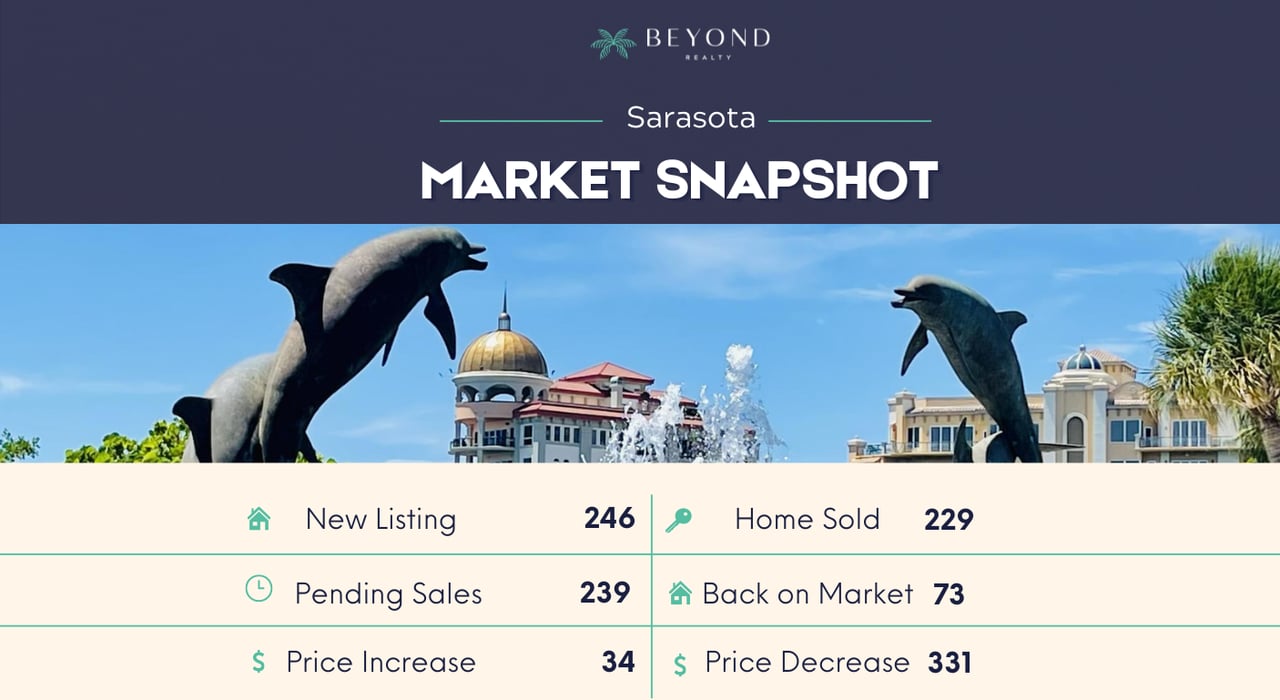

Navigating Local Shifts, Local Inventory, and Mortgage Rate Forecasts Along Florida’s Gulf Coast

Student loan debt does not automatically prevent you from buying a home in Sarasota, Lakewood Ranch, or Southwest Florida. Learn how lenders evaluate debt, income, and… Read more
How to Sell for Maximum Value or Buy with Confidence in Sarasota, Lakewood Ranch, Manatee County & Charlotte County

You’ve got questions and we can’t wait to answer them.