The “Tax Divorce”: How to Relocate from High-Tax States to Sarasota or Lakewood Ranch the Right Way
Darren Dowling

Darren Dowling
Changing your tax home to Florida requires changing your domicile, not just buying a house in Sarasota or Lakewood Ranch. File a Declaration of Domicile with the Sarasota County or Manatee County Clerk of the Circuit Court, apply for homestead exemption, and document the move. High-tax states audit this.
Residency is where you live. Domicile is your one permanent legal home, the place you intend to return to. You can have several residences and only one domicile, and it is domicile that generally determines which state can tax your income.
This distinction is where most relocating buyers go wrong, because the words are used loosely in conversation and precisely in tax law. A New York or New Jersey resident who buys in Lakewood Ranch, spends winters there and keeps an apartment, a job, a doctor and a country club up north has bought a second residence. They have probably not changed their domicile.
Departure states also apply a separate statutory residency test. New York, for example, can treat you as a resident for income tax purposes if you maintain a permanent place of abode in the state and spend more than 183 days there, regardless of where your domicile is. That means you can lose the domicile argument and the day-count argument independently.
Concept | What it means | How it is tested |
|---|---|---|
Residence | A place you live | Physical presence |
Domicile | Your one permanent legal home | Intent plus objective facts |
Statutory residency | A day-count rule in the departure state | Permanent abode plus day threshold |
Homestead | Florida property tax and creditor protection status | Ownership and occupancy as of January 1 |
File a Declaration of Domicile, apply for homestead exemption, get a Florida driver's license and vehicle registration, register to vote in Sarasota or Manatee County, and move the center of your life. Then document all of it and keep the records.
There is no single act that accomplishes this. Auditors weigh a pattern of facts, and the pattern is what persuades. The steps below are the ones that recur in residency audits.
Step | Where it happens | Notes |
|---|---|---|
Declaration of Domicile | Sarasota or Manatee County Clerk of the Circuit Court | Sworn statement under Florida Statute 222.17 |
Homestead exemption | County property appraiser | Apply by March 1, own and occupy as of January 1 |
Florida driver's license | Florida Highway Safety and Motor Vehicles | Surrender the out of state license |
Vehicle registration and title | Florida tax collector office | Confirm current deadlines with the state |
Voter registration | County supervisor of elections | Cancel registration in the departure state |
Banking and advisers | Local institutions | Move primary accounts, update addresses |
Estate documents | Florida attorney | Re-execute will and trusts under Florida law |
Professional relationships | Local | Physicians, dentists, accountant, attorney |
The last two lines matter more than people expect. Auditors look at where your doctors are, where your safe deposit box is, where your dog is registered and where the items of sentimental value live. The New York Department of Taxation and Finance has literally asked about the location of family heirlooms.
Up to fifty thousand dollars off assessed value, a Save Our Homes cap limiting annual assessed value increases to three percent or CPI, whichever is lower, portability of up to five hundred thousand dollars of accumulated savings, and constitutional creditor protection on your primary residence.
The mechanics are worth understanding precisely, because the exemption is often described inaccurately. The first twenty five thousand dollars applies to all taxing authorities. An additional twenty five thousand dollars applies to assessed value between fifty thousand and seventy five thousand dollars, and it does not apply to school district taxes.
The Save Our Homes cap is the larger long-term benefit for most owners, because it compounds. It also resets on transfer, which is why the seller's tax bill tells you nothing useful about your own.
Florida's homestead creditor protection comes from the state constitution and is separate from the tax exemption. It protects the homestead from most creditors, subject to acreage limits, generally half an acre inside a municipality and up to one hundred sixty acres outside one. It has exceptions, including mortgages, tax liens and construction liens.
Applying for homestead in Florida while claiming a residency-based property tax benefit in another state is a well-known audit trigger. If you had a STAR credit in New York or a similar benefit elsewhere, cancel it.
Day counts, the disposition of your former home, where your employment and business activity sit, where your family lives, where your professional advisers are, and whether the pattern of your life actually moved. Credit card records and mobile phone location data are routinely used.
High-tax states run these audits as a matter of routine, and they are well resourced. The defense is documentation gathered contemporaneously, not reconstructed three years later.
What auditors examine | What helps your position |
|---|---|
Days in each state | A contemporaneous day-count log with supporting records |
Former residence | Sold, or at minimum materially downsized in use |
Home size and value | Florida home comparable to or larger than the former one |
Employment and business | Work performed and directed from Florida |
Family location | Spouse and dependent children relocated |
Advisers and professionals | Florida physicians, dentists, CPA, attorney |
Club and religious affiliations | Memberships moved to Sarasota or Manatee County |
Valuables and pets | Located in Florida |
Vehicle and license | Florida issued, out of state surrendered |
A day-count log is unglamorous and it is the single most valuable thing you can maintain. Record where you slept each night, and keep the receipts, boarding passes and toll records that corroborate it.
Yes, considerably. Florida homestead requires ownership and occupancy as of January 1 and an application by March 1. Departure state day counts run on the calendar year, and a mid-year move means you will likely file a part-year return in the departure state.
Buyers frequently close in spring or summer with the intention of establishing Florida domicile that year, then discover they have missed the January 1 homestead condition for the current tax year and will not receive the exemption until the following year. The house is fine. The tax expectation was wrong.
The other timing trap is the day count. If you move in July and spend more than the statutory threshold in your departure state before you leave, you may still meet that state's residency test for that year even if your domicile change is otherwise clean.
Downtown Sarasota for walkability, Lakewood Ranch for amenities and resale depth, Waterside for new construction in Sarasota County, Palmer Ranch for established value, and Siesta Key or Venice for beach access. The choice affects your millage, not your income tax.
Once you are a Florida domiciliary, the income tax outcome is the same anywhere in the state. What changes by community is the property tax and carrying cost picture.
Area | County | Municipal millage applies? | Notes for relocating buyers |
|---|---|---|---|
Downtown Sarasota | Sarasota | Yes, City of Sarasota | Walkable, condo-heavy, arts district |
Lakewood Ranch core | Manatee | Mostly no | Master-planned villages, CDD assessments common |
Waterside at Lakewood Ranch | Sarasota | No | Sarasota County schools, newest construction |
Palmer Ranch | Sarasota | No | Established, near the Legacy Trail |
Siesta Key | Sarasota | No | Barrier island, coastal flood zones |
Venice | Sarasota | Yes, City of Venice, in part | Coastal town, mixed build eras |
Wellen Park | Sarasota | Yes, City of North Port, mostly | Newer construction, Venice mailing addresses |
Bradenton | Manatee | Yes inside city limits | Broad range of price points |
Layer the CDD assessment on top of millage and the ranking often changes relative to what list prices suggest. This is the part a broker can actually verify for you, parcel by parcel, from the county tax roll.
Keeping the former home in full use, undercounting days, claiming a residency-based tax benefit in two states, leaving business activity and advisers behind, and treating the Declaration of Domicile as the finish line rather than the starting gun.
The pattern in failed cases is consistent. Someone files the declaration, gets the Florida license, and then continues to live, work, bank, doctor and socialize exactly as before, spending five months a year in Florida and calling it a move. The paperwork was fine. The facts were not.
The second most common failure is a spouse who does not move. If one spouse remains domiciled in the departure state with the family home intact, the audit becomes considerably harder to win.
A CPA experienced in multi-state residency, an attorney licensed in your departure state, a Florida estate attorney and a broker who verifies the property-level facts. Beyond Realty handles the last of those and coordinates with the rest.
To be clear about scope, we are brokers, not tax advisers or attorneys. Nothing in this article is tax or legal advice, and residency rules differ meaningfully between New York, New Jersey, Connecticut, Illinois, California, Massachusetts and Minnesota. Get advice specific to your departure state before you rely on any of this.
What we do handle is the property side. Which county the parcel sits in, what the CDD assessment costs and how many years remain, what the HOA budget and reserves look like, what the flood determination says and what a carrier will actually quote for insurance.
There is no single Florida day threshold that grants residency, which surprises most people. Florida does not levy a personal income tax, so it has little reason to police the question. The day counting that matters happens in your departure state. New York, for example, can treat you as a statutory resident if you maintain a permanent place of abode there and spend more than 183 days in the state, regardless of your domicile. Rules differ by state, so get advice specific to where you are leaving and keep a contemporaneous log of where you sleep each night.
A Declaration of Domicile is a sworn statement under Florida Statute 222.17 declaring that Florida is your permanent home. You file it with the Clerk of the Circuit Court in the county where you live, so the Sarasota County Clerk for Sarasota, Siesta Key, Palmer Ranch, Venice, Osprey and Waterside, or the Manatee County Clerk for most of Lakewood Ranch and Bradenton. It is useful evidence of intent, but it is only one factor. Filing it while continuing to live primarily in another state will not, on its own, change your tax home.
You can, and many people do, but it weakens your position considerably if you keep it in full use. Auditors compare the two properties on size, value and actual usage, and a retained former residence that remains fully furnished, staffed and frequently occupied is one of the strongest facts against a domicile change. If you keep it, materially reduce your use of it, keep records showing that, and consider whether the tax saving justifies the audit risk. Discuss this with a CPA experienced in multi-state residency before you decide.
You must have owned and occupied the property as your permanent residence as of January 1 of the tax year, and the application deadline is March 1. Closing in spring or summer means you generally will not receive the exemption until the following tax year, which catches many relocating buyers off guard when the first tax bill arrives. Apply through the Sarasota County or Manatee County Property Appraiser. If you claimed a residency-based property tax benefit in another state, cancel it, because holding both is a well-known audit trigger.
Florida levies no state estate tax and no state inheritance tax, which is a meaningful consideration if you are leaving a state that imposes one. Federal estate tax still applies regardless of where you live. Changing domicile also means your will, trusts and powers of attorney should be reviewed and generally re-executed under Florida law, both because Florida formalities differ and because the documents themselves become evidence of your domicile. This is squarely attorney territory. Engage a Florida estate attorney alongside your CPA rather than relying on general guidance.
Beyond Realty times the closing against the January 1 homestead condition and the March 1 application deadline, verifies the county and millage stack for the specific parcel, and pulls the CDD balance and insurance quote before you commit.
Beyond Realty is based in downtown Sarasota and works across Sarasota and Manatee counties, in Lakewood Ranch, Waterside, Palmer Ranch, Siesta Key, Downtown Sarasota, Bradenton, Venice, Wellen Park, Osprey and Nokomis. Get in touch or read more about Darren Dowling.
Darren Dowling, Broker-Owner
Beyond Realty
2170 Main Street, Suite 103
Sarasota, FL 34237
(941) 204-0493
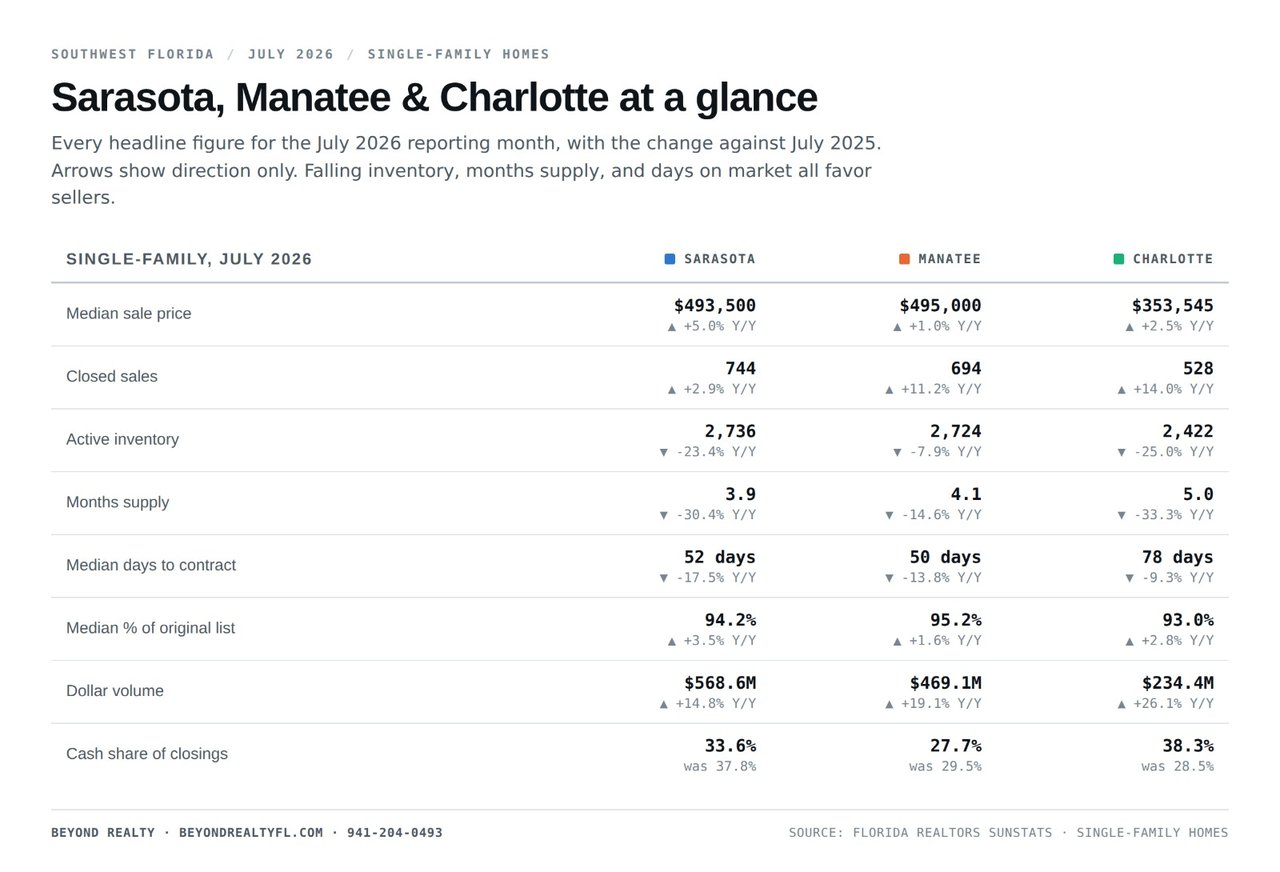
Sarasota, Manatee & Charlotte County Market Report (July 2026): Supply Keeps Tightening. Prices Have Been Flat Since April
How Sarasota, Manatee, and Charlotte County Homeowners Can Price, Market, and Sell With Confidence

A practical guide for Sarasota, Lakewood Ranch, Manatee County, and Southwest Florida homeowners who want to reduce the risk of a failed home sale.
Your Home Equity Could Be the Key to Your Next Move in Sarasota, Lakewood Ranch, and Southwest Florida
You’ve got questions and we can’t wait to answer them.